

A grinder is the upgrade almost every stained glass maker adds right after their first project: it turns a slow, hand-pad edge job into a five-second pass against a spinning, water-cooled diamond bit. But “just buy a grinder” skips two real questions: bench or hand-pad, and which bit size and water-feed setup fits how you work. It also skips the wet-grinding safety habits that are easy to overlook in a home workshop.
This guide covers how to choose between grinder types, the specs worth paying for, the respiratory and hearing safety points specific to wet-grinding glass, and what a realistic budget looks like at each tier. If you still need cutters, pliers, and the rest of the bench, see our complete glass-cutting toolkit guide.
Key Takeaways
- A grinder isn’t required for a first project — fine-grit hand pads work for a small piece count — but almost every maker adds one once they’re grinding more than a dozen edges per panel.
- Bit diameter (typically 5/8″ and 1″) and a working water-feed system matter more than motor size for everyday results.
- Wet grinding produces a fine glass-and-water slurry; OSHA’s respirable crystalline silica standard sets an 8-hour exposure limit of 50 micrograms per cubic meter, with an action level of 25 (OSHA, 29 CFR 1910.1053).
- About 16% of US workers (roughly 27 million people) reported hazardous noise exposure in the past year, and OSHA’s 8-hour noise limit is 90 dBA, with a hearing-conservation action level at 85 dBA (NHIS 2023 data via CDC/NIOSH, published May 2025; OSHA 29 CFR 1910.95).
- A basic bench grinder runs roughly $60-$100; mid-range kits with more bit sizes land around $150-$220, and premium diamond-bit setups run $300 and up, based on current retailer listings.

Bench vs. Hand-Pad Grinders: Which Do You Actually Need?
You don’t need a grinder for your very first stained glass project. Fine-grit hand pads (or even folded sandpaper) can smooth the edges on a small sun catcher or a panel under a dozen pieces, and plenty of beginners start there before spending anything on equipment.
A bench grinder is a stationary, water-cooled unit: you guide the glass edge against a vertical diamond bit while a reservoir wicks water up to keep both the glass and the bit cool. This is the standard studio tool, and it’s the fastest way to true up an edge or fine-tune a piece’s fit against its neighbors before foiling. Hand-pad grinding — fine sandpaper blocks or diamond hand pads — stays useful for occasional touch-ups even after you own a bench grinder, since it’s quieter and needs no setup for a single stray edge.
The honest trigger for buying a bench grinder isn’t ambition — it’s piece count. Once you’re grinding more than 10-15 edges per project, hand-pads start costing you more time than a $70-100 entry grinder is worth.
One category worth a note of caution: some marketplace listings now market “cordless” or battery-powered glass grinders. As of this writing, that’s a thin, largely unreviewed category rather than an established alternative to corded bench units — treat cordless listings as unproven until independent reviews catch up, not as a like-for-like substitute.
The Specs That Actually Matter When Buying a Grinder
Three specs decide how a grinder performs day to day, and none of them is “how many horsepower.”
Bit diameter and grit. Most stained glass grinders ship with a 5/8″ bit for general edge work and a 1″ bit for faster stock removal or tighter inside curves; some kits add a smaller bit for very tight notches. Grit is typically sold in a coarse/standard/fine range (often marketed as 80/100/220-grit equivalents) by the bit manufacturer — coarse removes glass fast, fine leaves a smoother pre-foil edge. These grit-size conventions come from grinder-bit manufacturers and retailers rather than an independent standards body, so treat them as practical shopping references, not lab-tested figures.
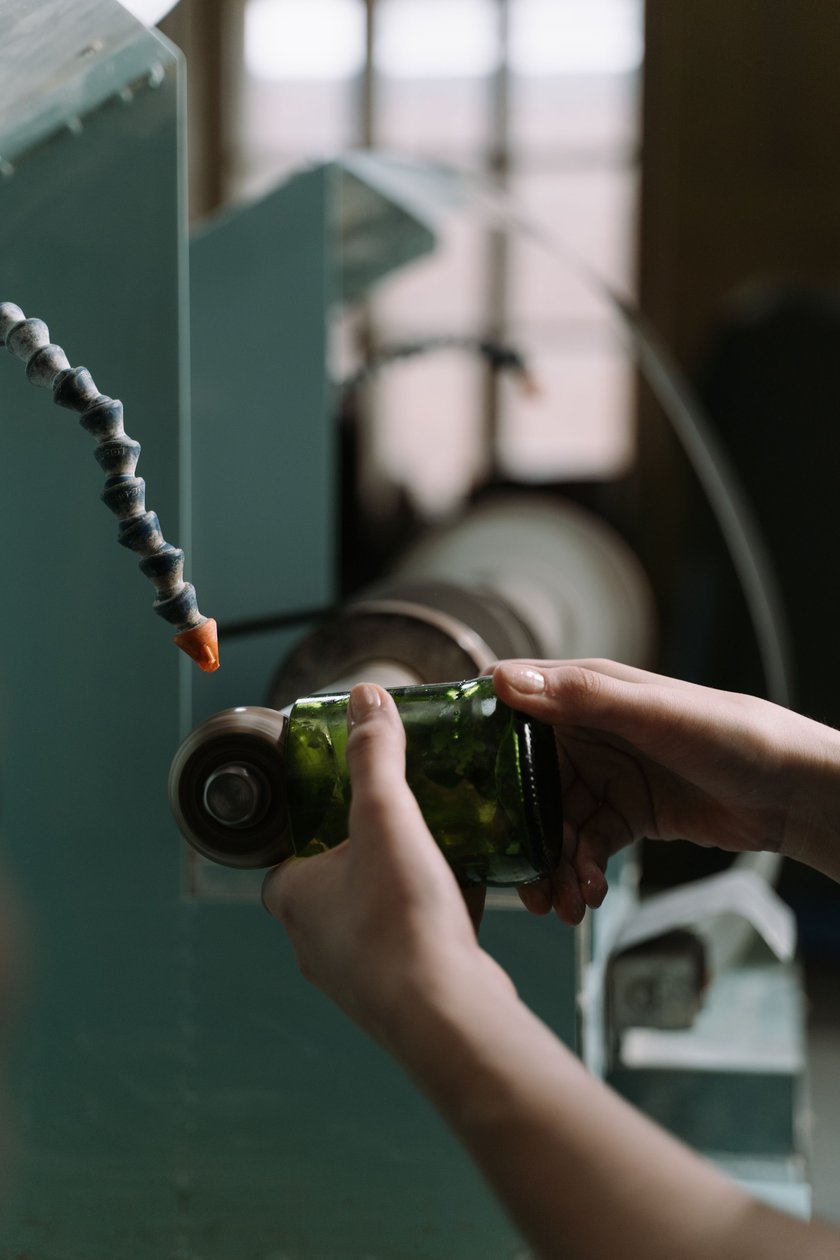
Water-feed system. Every legitimate stained glass grinder is water-cooled — dry-grinding glass throws far more fine dust and burns through bits fast. Cheaper units use a felt or sponge pad that wicks water up from a small reservoir; pricier ones add a flexible feed hose you can aim directly at the bit, which is the setup you can see in the photo above. A worn or missing wicking pad is the single most common reason a used or budget grinder underperforms — check that it still wicks water reliably before you assume the motor is the problem.
Noise level. Bench grinders run for minutes at a stretch during a big project, and motor + water-spray noise varies noticeably between models. There’s no independently tested decibel database for hobby glass grinders, so this is one to gauge from review videos rather than a spec sheet — see the safety section below for why it’s worth caring about.
Upgrade Pick: Best Replacement Diamond Bits for Smoother Edges
Once you own a grinder, the single biggest lever on edge quality usually isn’t the machine itself — it’s the diamond bit doing the actual grinding. A worn, glazed-over, or mismatched bit will leave rough, chipped edges on a perfectly good grinder, which is why makers sometimes blame the machine for a problem a fresh bit would solve in five minutes.
Stock bits that ship with entry and mid-range kits also tend to cover just one or two sizes. Adding a full set — including a small 1/8″ bit for tight inside curves and notches — means you’re not forcing an oversized bit into a corner it was never meant to grind.
Our Pick For Replacement Bits · Affiliate Link
Ecarke Diamond Grinder Bit Head Set (4 Sizes, Brass Core)
A set of four diamond grinder bit heads — 1″, 3/4″, 1/4″, and 1/8″ — with a double-plated diamond bonding surface and a brass core that resists shaft binding during regular water-fed use. The 8mm bore fits standard grinder shafts, and having all four sizes on hand means tight curves and inside notches get a properly sized bit instead of whatever’s already mounted.
Check Current Price on AmazonDisclosure: that’s an affiliate link. If you buy through it, we may earn a small commission at no extra cost to you. See our full affiliate and third-party disclosure for details.
Signs It’s Time to Replace Your Grinder Bit
- Grinding slows down noticeably on glass that used to go fast — the diamond coating is glazing over.
- You can see flat spots or bald patches where the diamond coating has worn through to the base metal.
- Edges come out rougher or more chipped than they did when the bit was new, even with a steady water feed.
- You keep forcing a 1″ or 5/8″ bit into tight inside curves because you don’t own a smaller size.
Respiratory Safety: Why Wet Grinding Still Makes Dust Worth Managing
Water-feed grinding exists specifically to keep glass dust down, and it works — but it doesn’t eliminate airborne fine particulate the way it can feel like it does, especially once the slurry dries on nearby surfaces and gets disturbed later. Glass itself contains crystalline silica, the same hazard regulators track in stone and concrete work.
OSHA’s respirable crystalline silica standard (29 CFR 1910.1053) sets a permissible exposure limit of 50 micrograms per cubic meter as an 8-hour time-weighted average. It also sets a lower action level of 25 micrograms per cubic meter that triggers additional monitoring in covered workplaces (OSHA). A related NIOSH-affiliated study of full-shift air samples at Georgia stone-fabrication shops between 2017 and 2023 found that 52% of 75 samples exceeded that 50 microgram limit (PMC, 2024-2025).
That population is stone-countertop fabricators, not stained glass hobbyists. Their dry-cutting exposure is almost certainly higher than a home grinder produces, but it’s the closest available data point for “cutting or grinding a silica-containing material without care.” That’s a reasonable case for a few basic precautions: keep the reservoir topped up so the pad or feed hose is actually wetting the bit, wipe down dried slurry rather than brushing it into the air, and avoid grinding for hours in an unventilated closet.
Noise: The Safety Issue Grinders Get Wrong
Silica gets most of the safety attention in glass-crafting circles; hearing damage gets almost none, despite being the more probable everyday risk of running a bench grinder for long stretches. OSHA’s general industry noise standard (29 CFR 1910.95) sets an 8-hour permissible exposure limit of 90 dBA. A lower 85 dBA action level triggers hearing-conservation requirements in covered workplaces (OSHA).
A 2023 National Health Interview Survey of US workers, published by CDC/NIOSH researchers in May 2025, found that about 16% of workers — roughly 27 million people — reported hazardous noise exposure in the past 12 months. Another 13% reported ototoxic chemical exposure, and 7% reported both (NHIS 2023 data, PMC). The same study attributed roughly half of preventable hearing difficulty among workers to a history of noise exposure.
No hobbyist needs a sound meter to run a home grinder safely, but basic hearing-conservation habits carry over directly: if you’re grinding for long, uninterrupted sessions, foam earplugs are a cheap, effective habit, and it’s worth noticing whether a specific model’s motor pitch makes you want to raise your voice to talk over it — a rough, informal proxy for “loud enough to matter over time.”

Eye protection matters here too, for the same reason it does at the cutting table: wet slurry still throws small fragments, so ANSI Z87-rated safety glasses belong at the grinder, not just the cutting mat.
Our Pick for a First Bench Grinder
Our Pick For Beginners · Affiliate Link
Godora Stained Glass Grinder Kit
Ships with dual 5/8″ and 1″ diamond bits, a water-wicking cooling feed, and a bottle of cutting oil — a straightforward, no-fuss bench setup for makers ready to move past hand-pads without overspending on their first unit.
Check Current Price on AmazonDisclosure: that’s an affiliate link. If you buy through it, we may earn a small commission at no extra cost to you. See our full affiliate and third-party disclosure for details.
How to Choose a Grinder by Budget
Entry ($60-100): A basic bench grinder with one or two diamond bit sizes and a felt-pad water feed. This covers panels in the 15-40 piece range without complaint, and it’s the right first purchase for most hobbyists moving off hand-pads.
Mid-range ($150-220): Adds a wider range of bit sizes, a more reliable flexible water-feed hose instead of a wicking pad, and generally a quieter, longer-lasting motor. This is where most makers land once they’re grinding regularly rather than occasionally.
Premium ($300+): Larger, sturdier bench units built for frequent, heavy use — bigger reservoirs, better-sealed motors, and bit assortments aimed at production-level piece counts rather than a weekend project. Worth it once grinding time, not tool cost, is your actual bottleneck.
These figures are aggregated from current listings at major craft and hardware retailers rather than a single audited price study — treat them as planning ranges, not fixed quotes.
| Tier | Typical Cost | What You Get |
|---|---|---|
| Entry | $60-100 | One or two bit sizes, felt-pad water feed |
| Mid-range | $150-220 | Wider bit range, flexible water-feed hose, quieter motor |
| Premium | $300+ | Larger reservoir, heavy-use motor, production-oriented bit assortment |
Common Mistakes When Buying or Using a Grinder
1. Buying a premium grinder before your first project. An entry-tier bench grinder is plenty for learning the technique. Save the larger, heavy-use units for once you know grinding time is genuinely your bottleneck.
2. Letting the water reservoir run dry. Grinding without adequate water feed throws more dust, wears bits out faster, and can crack glass from heat buildup. Check the reservoir and the wicking pad or feed hose before every session, not just when you remember.
3. Skipping eye and hand protection at the grinder specifically. It’s easy to gear up for cutting and forget the grinder produces its own spray and fragments — ANSI Z87-rated glasses belong at both stations.
4. Ignoring bit wear. A worn diamond bit grinds slower and can chip edges instead of smoothing them. If a bit that used to remove glass quickly now feels sluggish, replace it before it costs you a cracked piece.
5. Grinding for hours with no hearing protection. A single short session won’t hurt you, but habitual long, unprotected sessions are exactly the pattern noise-exposure research flags as cumulative risk. Foam earplugs cost pennies per pair.
Frequently Asked Questions
Do I need a grinder to start stained glass, or can I use hand pads?
You don’t need one to start. Fine-grit hand pads can smooth edges on a small first project under about a dozen pieces. A grinder becomes worth the cost once you’re regularly grinding more edges than that per project, since hand-grinding a full panel is slow.
What bit sizes do I actually need?
Most beginners are well served by the standard 5/8″ and 1″ bit pairing that ships with most entry and mid-range kits — 5/8″ for general edge work and tight curves, 1″ for faster stock removal on straighter runs. Extra specialty bit sizes are a later upgrade, not a starting requirement.
Are cordless or battery-powered glass grinders worth buying?
Not yet, as a rule. Independent reviews of cordless glass grinders remain thin, and the established, well-reviewed category is still corded, water-fed bench units. Treat cordless listings as unproven rather than a direct substitute until that changes.
How dangerous is the dust from grinding stained glass, really?
Wet grinding meaningfully reduces airborne dust compared to dry grinding, and hobby-level exposure is very likely far below what’s been measured in industrial dry-cutting studies. That said, glass contains crystalline silica, and OSHA’s exposure limits exist because cumulative exposure — even at lower, hobby-level intensity — is the actual risk, not any single grinding session. Keep the water feed working and wipe down dried slurry instead of brushing it airborne.
Is the Godora Stained Glass Grinder Kit a good first grinder?
It covers the two fundamentals a first grinder needs — a working water-feed system and both a 5/8″ and 1″ bit — without asking a beginner to pay premium-tier prices for features that only matter at higher production volume.
Conclusion
Start without a grinder if your first project is small, but budget for an entry-tier bench unit as soon as you’re grinding more than a handful of pieces per panel — the water-feed system and a 5/8″/1″ bit pairing matter far more to daily results than motor size or price. Treat the wet slurry with the same basic respect you’d give any silica-containing material, protect your hearing on long sessions, and upgrade to a mid-range or premium unit only once grinding time, not tool capability, is actually slowing you down.
Ready to put a grinder to work on your next panel? Follow our complete copper foil method walkthrough from score to finished piece, or check our full glass-cutting toolkit guide for the cutters, pliers, and safety gear that round out your bench.
7 Responses